Tesla LFP vs NMC Batteries: What's the Difference, and Which Should You Buy?
Shop for a used Tesla and you hit a wall of jargon fast: LFP, NMC, NCA, 2170, 4680. One distinction untangles most of it — chemistry (what the battery is made of) versus format (the physical shape of the cell). People mix these up constantly. LFP is a chemistry. 4680 is a format. Once that clicks, the rest gets simple. Here's the honest version: what LFP actually is, why people rave about it and where the hype overshoots, how it stacks up against nickel packs, exactly which Teslas have which battery, and how to confirm what's in the specific car in front of you.
Find your match, then never miss it.
Browse every used Tesla in the US free, or set a $29 alert and we ping you the moment your car appears or drops in price.
What is an LFP battery?
LFP stands for lithium iron phosphate (LiFePO4). It describes the cathode chemistry — the elemental recipe of one of the cell's two main electrodes. The defining trait is what it leaves out: no nickel and no cobalt, just iron and phosphate, both cheap and abundant.
That has knock-on effects. LFP cells run at a slightly lower voltage (~3.2V per cell, versus ~3.6–3.7V for nickel cells) and store less energy for their weight — roughly 90–205 Wh/kg at the cell level, against 200–300+ Wh/kg for the best nickel cells. In plain terms: an LFP pack is heavier and bulkier for the same range. That's why Tesla put it in the entry trims, not the long-range ones.
In a Tesla, LFP cells are physically prismatic — flat rectangular cans, sourced from CATL in China — not cylindrical. Hold onto that detail; it matters when we get to the 4680 confusion below.
Why everyone says LFP is great (and the 100% charging thing)
LFP gets praised for two real, separate reasons that often get blurred together.
One: it shrugs off a full charge. Nickel cells dislike sitting at 100% — high state of charge stresses them — so Tesla tells nickel owners to keep the daily limit around 80–90% and save 100% for trips. LFP tolerates a high charge far better, so Tesla's Model 3/Y owner's manual flips the advice: keep the daily charge limit at 100%, and fully charge to 100% at least once a week. Genuinely convenient — no sliders to babysit, full usable range every morning.
Two (the part people miss): calibration. The weekly 100% charge isn't only about range — it's how the car keeps its range estimate honest. LFP has a very flat voltage curve: voltage barely changes across most of the charge range, so the battery management system can't read state of charge from voltage precisely. The estimate drifts over time. Charging to a known 100% endpoint re-anchors it. This is why an LFP Tesla with a weird range readout can suddenly "find" miles after a full charge — it recalibrated, it didn't heal.
One caveat the marketing skips: 100% is not literally damage-free for LFP. A peer-reviewed study from Jeff Dahn's Tesla-funded lab found that the higher the average state of charge, the faster LFP cells fade — habitually sitting near the top does still age them. The researchers stopped short of recommending a habit change, but for a blunt reason: cycling only in the 0–25% band would waste most of the pack's usable capacity. So treat "never degrades" as a myth. LFP degrades slowly — it really does degrade — and if you want to baby a long-term keeper, a slightly lower average charge helps. For most owners, Tesla's once-a-week 100% routine is the right trade for calibration and convenience.
LFP vs the alternatives
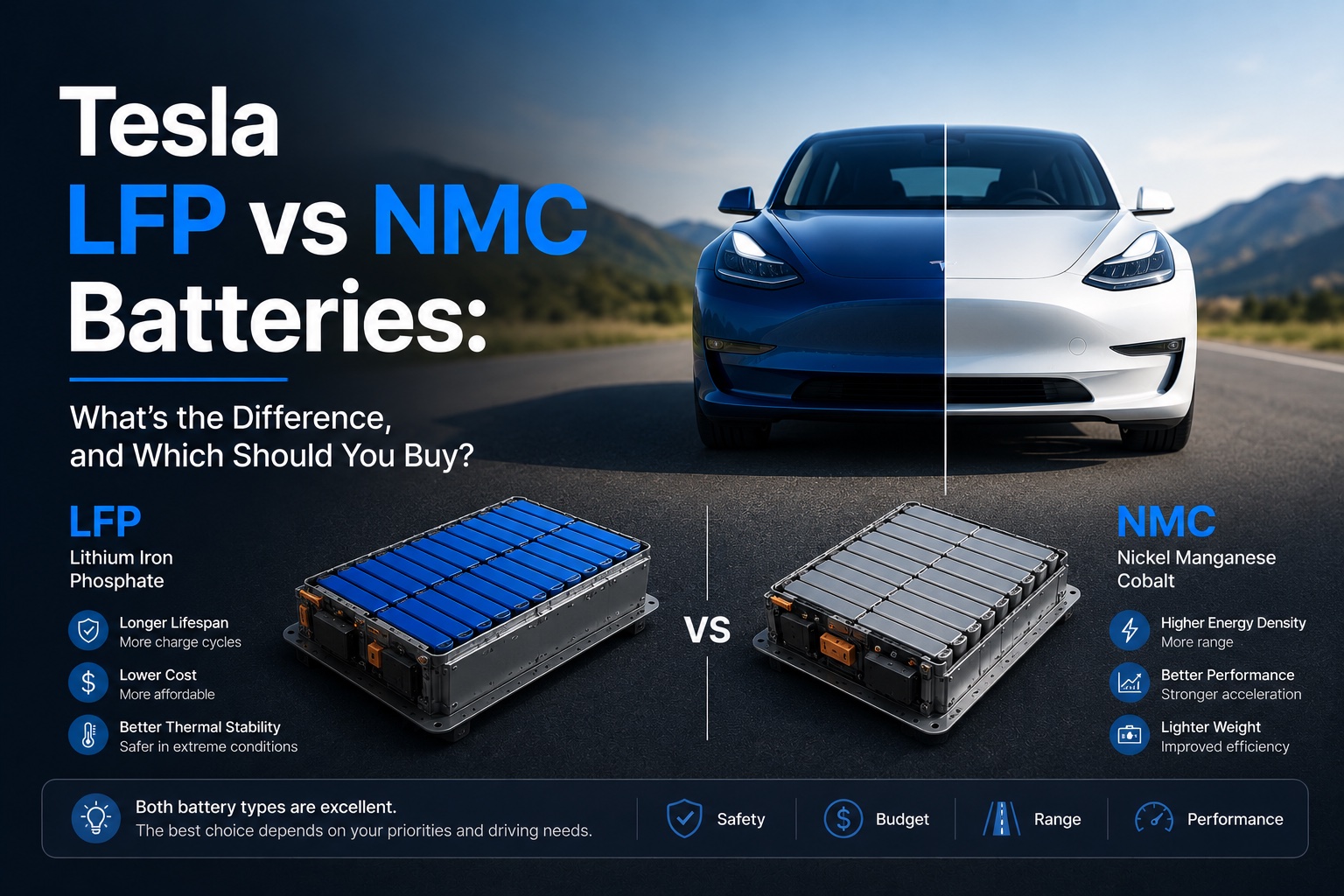
The alternative to LFP is nickel-based chemistry — either NMC (nickel-manganese-cobalt) or NCA (nickel-cobalt-aluminum). The trade-off in one line: nickel gives you more range and power; LFP gives you longer life, lower cost, better safety, and stress-free 100% charging.
- Energy density: Nickel wins. More range per pound and per liter — the reason every Tesla Long Range, Performance, Model S, Model X, and Cybertruck uses nickel.
- Cycle life: LFP wins, and not by a little. Spec ratings run roughly 3,000–4,000+ full cycles to 80% capacity for automotive LFP, versus roughly 1,000–1,500 for nickel. The "million-mile" headlines are lab best-cases, though — real-world pack life is driven more by calendar age and charging habits than raw cycle count.
- Cost & ethics: LFP is meaningfully cheaper per kWh and uses no cobalt, sidestepping the chemistry's worst ethics problem — most mined cobalt comes from the DRC, with documented child-labor links. (LFP still uses lithium, so it's lower-impact, not zero-impact.)
- Safety: LFP is the more thermally stable chemistry. Its cathode doesn't readily release oxygen when overheated, so it's harder to push into thermal runaway and burns cooler.
- Cold weather: Nickel wins. In deep cold, LFP loses more range and charges slower, though preconditioning the pack before a Supercharger stop largely closes the gap.
Now the jargon trap: 2170 and 4680 are NOT chemistries. They're cell formats — physical sizes of cylindrical cans (2170 = 21mm x 70mm; 4680 = 46mm x 80mm). So lining up "2170 vs 4680 vs LFP" as three rival options is simply wrong. Think in two axes: chemistry (LFP or nickel) and format (prismatic, 2170, 4680). The same format can hold different chemistries — BYD even builds an LFP cell in the exact 4680 size. And to kill the most common myth outright: Tesla's own 4680 cells are nickel-based, not LFP. The first-generation 4680 was high-nickel NMC 811 (~81.8% nickel). The big 4680 size was about manufacturing and structural-pack gains, not a switch to LFP.
Which Teslas have which battery
Here's the US-market mapping. Treat it as a strong starting point, then verify on the actual car (next section) — Tesla changes specs by batch and region without announcing it.
- LFP: only ever the cheapest rear-wheel-drive trims. The Model 3 RWD / Standard Range Plus ran LFP continuously from late 2021 until it was dropped from the US lineup on October 2, 2024 — including the 2024 Highland RWD (60.9 kWh, 272 mi EPA). Important: despite persistent launch-day rumors, the US Model Y RWD is NOT LFP — it ships with nickel (2170 NCA) cells. Tesla has never sold an LFP Model Y in the US; those exist only in China and Europe.
- Nickel (NMC/NCA): every Long Range, Performance, and AWD Model 3 and Model Y; all Model S and Model X (which have never used LFP); and the Cybertruck (high-nickel 4680). After October 2024, the entry US Model 3 became the nickel-pack Long Range RWD (363 mi EPA).
- The practical takeaway: in the US used market, an LFP Tesla is almost always a 2021–2024 Model 3 RWD / Standard Range. Anything else — any Long Range, Performance or AWD car, any Model Y, Model S, Model X, or Cybertruck — is nickel.
A note on the 4680: it's mostly a Cybertruck cell, with some Model Y use that Tesla expanded in early 2026. Most used Highland Model 3s run LFP (the RWD) or 2170 nickel (the Long Range), and most Juniper Model Ys run 2170 nickel — so don't assume a recent car has a 4680 just because it's new.
Quick pros & cons
LFP — pros
- Charge to 100% daily, no babysitting the slider
- Longest cycle life (roughly 2–4x nickel on spec ratings); ages slowly in real-world use
- Cheaper, cobalt-free, more ethically sourced
- Safest, most thermally stable chemistry
LFP — cons
- Lower energy density — less range, found only on entry trims
- Worse in deep cold (range and cold fast-charging)
- Range estimate drifts; needs a weekly 100% charge to recalibrate
Nickel (NMC/NCA) — pros
- Higher energy density — more range and power; powers all Long Range/Performance/S/X cars
- Better cold-weather performance
Nickel — cons
- Keep daily charging in the “Daily” range (about 80–90%); save 100% for trips
- More expensive, contains cobalt, less thermally stable
- Tends to lose capacity somewhat faster than LFP over a long life
Which is best for you?
Buy LFP if you mostly do local and commuter driving, live in a mild-to-moderate climate, want the lowest-stress ownership (charge to 100%, forget about it), care about cobalt-free sourcing, or want the most affordable used Tesla with the most durable pack. The sweet spot: a 2021–2024 Model 3 RWD — cheap, long-lived, and you stop thinking about charge limits.
Buy nickel if you need maximum range, want the quicker Long Range or Performance trims, road-trip often, or live somewhere with hard winters and outdoor parking — nickel holds more usable range in deep cold and charges faster from a cold pack. Any Long Range, Performance, Model S, or Model X gives you a nickel pack by default.
On degradation, both age well. Tesla's own data puts nickel packs around 85–88% capacity after 200,000 miles, and independent fleet data (Recurrent, InsideEVs) suggests LFP holds up at least as well, fading a little more slowly over a long life. Don't over-index on chemistry alone — how the previous owner charged and Supercharged matters as much as what's in the pack.
How to check a specific car's battery: don't trust the trim badge alone. On the car, open Controls > Software > Additional Vehicle Information — an LFP car lists "High Voltage Battery type: Lithium Iron Phosphate." The fastest tell is the charge screen: LFP cars show plain 50% / 100% markers; nickel cars show "Daily" and "Trip" labels. And if a used LFP car's range readout looks low, run a full 100% charge to recalibrate before assuming the pack is worn.
Not sure which one fits how you actually drive? usedtesla.ai is a fast, independent search front-end over Tesla.com's own used listings (we're not affiliated with Tesla). It shows the true all-in price including distance-based delivery, flags accident history and clean-title status, and verifies HW3 vs HW4 from Tesla's per-car hardware record — so you can filter for the trim, range, and battery profile you want. Free to browse; a one-time $29 pass adds 60 days of alerts (7-day money-back). You pay Tesla the same price either way.
Frequently asked questions
Which Teslas have LFP batteries?
In the US, essentially one: the Model 3 RWD / Standard Range Plus, which used LFP from late 2021 until it was dropped from the US lineup on October 2, 2024 (including the 2024 Highland RWD). Despite common rumors, the US Model Y RWD is NOT LFP — it uses nickel (2170 NCA) cells, and Tesla has never sold an LFP Model Y in the US. Every Long Range, Performance, and AWD trim, plus all Model S, Model X, and Cybertruck, is nickel-based too. Specs change by batch, so always confirm on the actual car.
Can I really charge an LFP Tesla to 100%?
Yes. Tesla's owner's manual tells LFP owners to keep the daily charge limit at 100% and to fully charge at least once a week. That does two things: gives you full range every day, and recalibrates the car's range estimate (LFP's flat voltage curve makes the estimate drift otherwise). The honest caveat: 100% isn't literally damage-free — a higher average state of charge still ages LFP a little — but it tolerates it far better than nickel, and the weekly full charge is what keeps the range readout accurate, so Tesla's routine is a sensible trade for most owners.
Is LFP better than NMC?
Neither is universally better — they trade off. LFP wins on cycle life, cost, cobalt-free sourcing, thermal safety, and stress-free 100% charging. Nickel (NMC/NCA) wins on energy density (more range and power) and cold-weather performance, which is why it's in every Long Range and Performance Tesla. For a mild-climate commuter, LFP is often the smarter buy; for maximum range or hard winters, nickel.
Do LFP batteries lose range in the cold?
Yes — somewhat more than nickel. LFP loses extra usable range in deep cold, and its cold fast-charging takes a big hit: in one real-world test, a Tesla Model 3 with a cold LFP pack charged at only roughly 20 kW, versus ~111 kW once warm. The gap is real but manageable — preconditioning the battery on the way to a Supercharger, and garaging the car, largely close it. If you regularly park outdoors through hard winters, a nickel pack has a genuine edge.
How do I know which battery my used Tesla has?
Don't rely on the trim badge alone — Tesla changes specs without notice. On the car, open Controls > Software > Additional Vehicle Information; an LFP car lists "High Voltage Battery type: Lithium Iron Phosphate." The quickest visual tell is the charge screen: LFP cars show plain 50% / 100% markers, while nickel cars show "Daily" and "Trip" labels. As a rule of thumb, a 2021–2024 US Model 3 RWD/Standard Range is almost always LFP.
Ready to find yours? Verified hardware, true all-in pricing, clean-history only.
Browse Tesla InventoryKeep reading