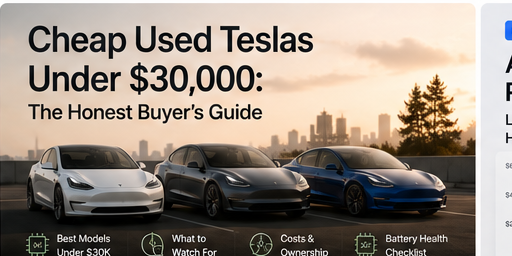
Cheap Used Teslas Under $30,000: The Honest Buyer's Guide
A used Tesla under $30,000 is easy to find — the average used Model 3 now sells in the mid-$20,000s. The hard part is telling a smart buy from a money pit. Three things decide that, and none of them show up in the headline price: the true all-in cost after delivery and tax, the battery's remaining health, and whether the car runs HW3 or HW4 — the silicon that caps what software it can ever get. This guide walks each one honestly, tradeoffs included.
Find your match, then never miss it.
Browse every used Tesla in the US free, or set a $29 alert and we ping you the moment your car appears or drops in price.
What $30,000 Gets You: Inventory, Mileage, and True All-In Pricing
At this budget you're realistically shopping 2019–2022 Model 3 and Model Y (mostly RWD/Standard trims), older Model S/X sedans, or higher-mileage performance variants. Expect odometers from the 50,000-mile range up past 120,000 — these are early buying-cycle cars and trade-ins. As new prices fall, lower-mileage examples surface, but they sell fast.
The listing price is not your final cost. On Tesla.com's used inventory, two things get added: a non-refundable transport fee and your state's tax and registration. Tesla states the transport fee runs roughly $500 to $2,500 by distance, with free pickup at a local delivery center if you'd rather drive it home. State sales tax typically adds another 6–10%. So a "$27,900" listing can land closer to $31,000–$33,000. If your hard ceiling is $30,000 out the door, you're really shopping listings in the $25,000–$27,000 range. The order deposit is $500, refundable only if Tesla financing is denied or you switch to a new-car order.
One more expectation to set: Tesla sells used cars as-is, with no return window (the 7-day return policy ended in 2020). It does run a 102-point inspection and adds a 1-year / 10,000-mile used-vehicle warranty on top of whatever's left of the original 4-year / 50,000-mile basic coverage — but what you inspect before delivery is what you keep.
- 2019–2022 Model 3 / Model Y — the sweet spot. Real-world range still comfortably clears 200 miles on most examples; degradation is slower than buyers fear (more below). Best value-per-dollar in this tier.
- Older Model S / Model X (2015–2019) — bigger, heavier, and pricier to repair. Worth it only if you need the space or the third row, not for outright value.
- History beats a clean slate — a car with one documented professional repair and a full service record usually beats an "accident-free" car with no paper trail at all.
Takeaway: price the car the way you'll actually pay for it — listing plus delivery plus tax. usedtesla.ai shows that all-in number, including the distance-based delivery fee, on every car so you're comparing apples to apples.
The Hardware Question: HW3 vs HW4 and Why It Decides Resale
This is the call that matters most at this price, because it sets a ceiling on what the car's software can ever do. Tesla has shipped two relevant Autopilot computers, and the model year alone won't tell you which one a given car has.
HW3 (shipped spring 2019 onward) is proven and stable, and it still gets Autopilot. But Tesla has confirmed HW3 cannot run its unsupervised, next-generation Full Self-Driving — that needs HW4's compute. Tesla has officially announced a stripped-down "v14 Lite" build for HW3 (think Start from Park, reverse, destination parking), targeted for mid-2026, but timing can slip and it is not the full feature set.
HW4 arrived on Model S/X in early 2023 and on Fremont-built Model Y around May 2023; every Cybertruck has it. It's the platform Tesla is building its current and future software around. (A common myth: HW4 doesn't add cameras — both HW3 and HW4 use eight. HW4's gain is higher-resolution cameras and more compute.)
- HW3 carries depreciation risk. The market increasingly prices in the FSD ceiling. When you resell in two or three years, the next buyer knows the same thing — so HW3 cars discount harder. You're effectively buying that obsolescence into the price.
- HW4 under $30k is rare. Most cars in this budget are HW3 — older inventory that has aged into the range. A sub-$30k HW4 car is usually higher-mileage or a recent trade-in; the future-proofing can justify the extra miles.
- You have to verify, not guess. Neither Tesla.com's used listings nor most dealers label the hardware clearly, and the cutoff years overlap. That information gap is exactly where buyers overpay.
Takeaway: don't infer hardware from the year. usedtesla.ai reads each car's AP_HARDWARE_VERSION straight from Tesla's per-car record and labels HW3 vs HW4 for certain — see our HW4 buyer's guide for the full breakdown.
Battery Health, Repair Costs, and the Real Tradeoffs
Degradation is real but front-loaded — and slower than the internet implies. Tesla packs lose the most early, then flatten out. Rough industry figures: about 95% capacity retained at 50,000 miles, ~88–90% at 150,000, and ~85–88% at 200,000. So a 150k-mile car has typically given up 25–40 miles of range, not half its pack. Climate and charging habits move these numbers, so confirm with a pre-purchase inspection from an independent EV shop.
The warranty you inherit. Tesla's Battery & Drive Unit warranty runs 8 years and — importantly — transfers with the VIN to you as a subsequent owner; it is not original-owner-only. It guarantees at least 70% retention within the term. Mileage caps vary by trim: 150,000 miles on Model S/X, 120,000 on Model 3/Y Long Range & Performance, and 100,000 on base RWD trims. Many sub-$30k cars are already past their mileage cap even if they're inside 8 years, so check both.
The catastrophic-failure number. If a pack fails out of warranty, replacement runs roughly $13,000–$16,000 on a Model 3/Y and ~$20,000–$22,000 on a Model S/X (refurbished or third-party packs can cost less). On a $30k car that's an existential repair — rare on a healthy pack, but the reason a real inspection matters.
- No home charging changes the math. Superchargers average roughly $0.30–$0.50/kWh in the US — two to three times typical home rates. Without a home plug, a used Tesla's per-mile fuel cost can approach a gas car's. Budget for this honestly.
- No federal used-EV credit anymore. The $4,000 used-EV tax credit (IRC 25E) ended for vehicles acquired after September 30, 2025. Don't pencil it into a 2026 purchase — it's gone.
- The upside is genuine. No oil, no transmission, no spark plugs. A 100k–150k-mile Tesla with clean service records and clean accident history often outlasts a newer combustion car with a murky past.
Takeaway: a cheap Tesla is a great buy with a healthy pack and a clear history, and a gamble without either. Inspect the battery, confirm warranty status by year and mileage, and price the charging reality.
How to Hunt Smart: Catching the Right Car Before It Sells
Tesla.com's used inventory turns over constantly — genuinely good cars can sell within hours, while overpriced ones sit for weeks. Speed and information win here.
- Filter tight, then move fast. Narrow to your model, price ceiling, and search radius. A strong listing posted at 10 AM may be gone by afternoon, so being early beats being thorough-but-late.
- Watch for price drops. Cars that linger often get marked down — a $30,500 listing can quietly become $28,500. Alerts on existing inventory catch these without you refreshing all day.
- Compare all-in, not list price. A $29,900 car and a $27,500 car can land within $1,000 of each other once delivery and tax are in. The lower sticker doesn't win if mileage, condition, or hardware don't back it up.
- Search geographically. Smaller metros and rural areas carry less demand-driven markup. The same Model 3 can run $2,000–$3,000 cheaper outside a major coastal city — sometimes enough to cover the delivery fee and then some.
- Flag the history. Prior-accident cars with a clean title aren't automatically bad — a documented repair can be fine — but a salvage, rebuilt, or branded title is a hard pass. Know which one you're looking at before you place a deposit.
What a real deal looks like: clean title, consistent service history, priced at or just below comparable recent sales, ideally HW4, and under its battery mileage cap. The rarest sub-$30k find — HW4, clean history, under 120,000 miles — is the one worth setting an alert for.
The buyers who save the most aren't the luckiest; they're the best-informed — they know a car's hardware for certain, its true all-in price, and how that price sits against recent sales. That's the gap usedtesla.ai is built to close.
Frequently asked questions
Can I really buy a used Tesla for under $30,000 all-in?
Yes — but aim for a listing in the $25,000–$27,000 range. On top of the sticker, Tesla adds a non-refundable transport fee (roughly $500–$2,500 by distance, or free local pickup) plus your state's sales tax and registration. That pushes a mid-$20,000s listing to right around $30,000 out the door. Most cars at this price are 2019–2022 Model 3 or Model Y.
Will the battery last, or will I need an expensive replacement?
Tesla packs are durable and degrade slowly after an early dip — roughly 88–90% capacity remaining at 150,000 miles. Full replacement is uncommon on a healthy car. If a pack does fail out of warranty, expect roughly $13,000–$16,000 on a Model 3/Y and ~$20,000–$22,000 on a Model S/X. The 8-year Battery & Drive Unit warranty transfers to you with the VIN, but mileage caps (100k–150k by trim) may already be exceeded — check both. Always get a pre-purchase battery inspection.
Does HW3 vs HW4 matter if I don't plan to pay for Full Self-Driving?
Yes, mainly for resale. HW3 still runs Autopilot, but Tesla has confirmed it can't run the full unsupervised next-generation FSD — only a limited "v14 Lite" build, targeted for mid-2026 (timing can slip). HW4 is the platform Tesla is building forward on, so it holds value better. HW4 is rare under $30,000 — most cars at this price are HW3 — which is exactly why verifying the hardware before you buy is worth it.
How do I know if a deal is actually good?
Compare the all-in price (listing + delivery + tax), not the sticker. Then weigh mileage against price, demand clean accident and service records over silence, and note days-on-inventory — a car that's sat a few weeks may have a price drop coming. A clean-title car at $28,000 with full history usually beats a $26,000 car with a mystery past.
What's the real operating cost after I buy?
It hinges on home charging. With a home plug, you're looking at roughly $0.05–$0.08 per mile. Relying on Superchargers (about $0.30–$0.50/kWh) pushes that toward $0.12–$0.20 per mile — close to a gas car. Home charging access is a core budget variable, not an afterthought. Note too that the federal $4,000 used-EV tax credit ended for purchases after September 30, 2025.
Ready to find yours? Verified hardware, true all-in pricing, clean-history only.
Browse used Teslas →Keep reading