What to Look For When Buying a Used Tesla
Two used Model Ys can list at the same price and be worth thousands apart — one runs the older Autopilot computer that will never reach unsupervised self-driving, the other doesn't. The year on the title won't tell you which is which. Neither will the photos. This guide is the short list of things that actually move the needle on a used Tesla: which Autopilot hardware it has, how the battery has really aged, what the warranty still covers, and which software perks follow the car versus die with the previous owner. Get these four right and you'll buy with confidence; skip them and you're gambling.
Find your match, then never miss it.
Browse every used Tesla in the US free, or set a $29 alert and we ping you the moment your car appears or drops in price.
Where You Buy Changes What You Get
You're choosing between two channels: Tesla's own used inventory on Tesla.com, or a third-party dealer or private seller. They differ in warranty, transparency, and — the part most buyers miss — whether software like Full Self-Driving survives the sale.
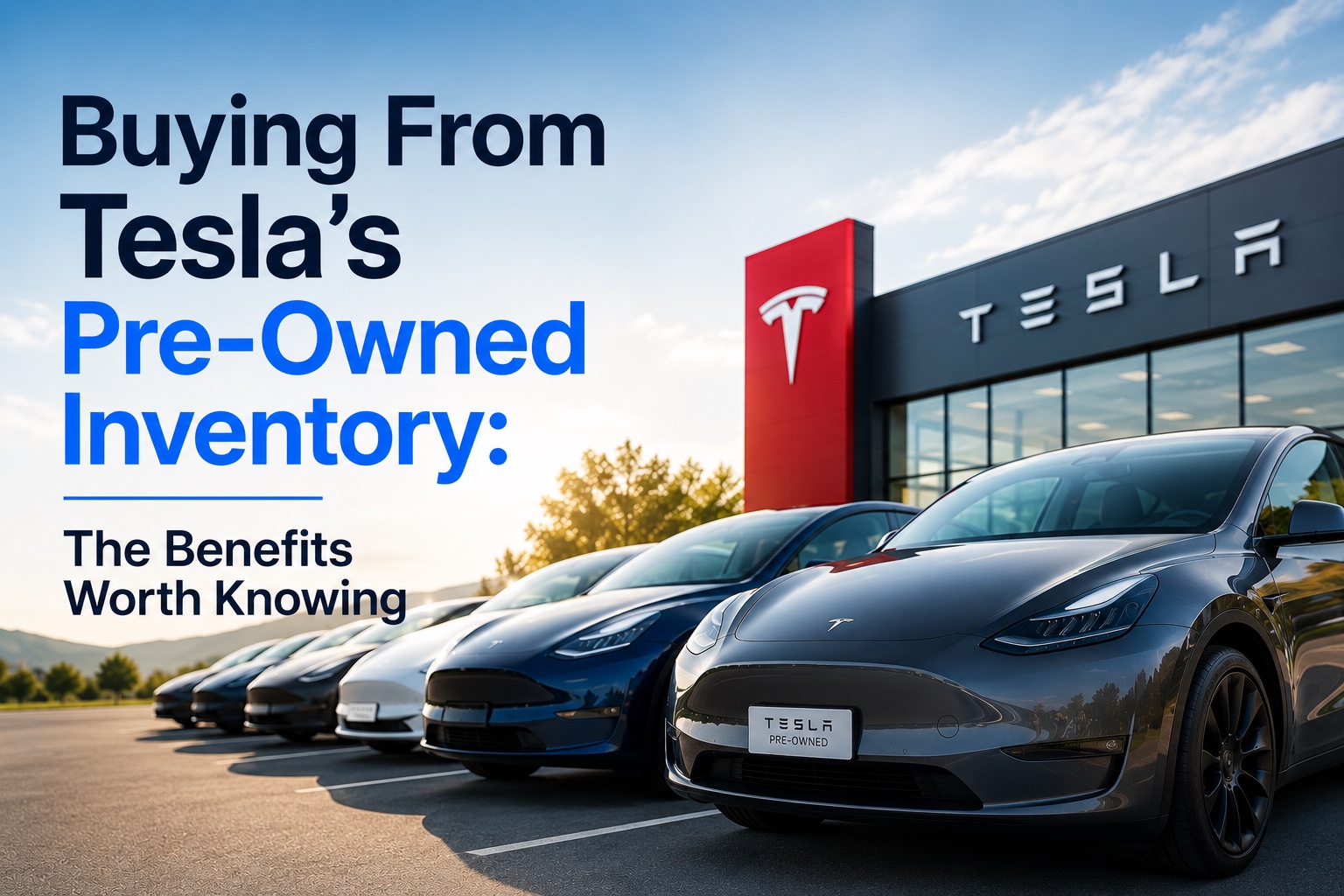
Buying from Tesla.com. Every used Tesla it sells has passed a 102-point inspection and carries a Pre-Owned warranty on top of whatever factory coverage remains (more on that below). Listings show a free AutoCheck history report, accident flags, and a delivery fee calculated to your ZIP. It's the transparent option — with one catch.
The Tesla.com catch. When a car is traded in to Tesla, Tesla can strip optional software — most notably Full Self-Driving — before relisting it. So a Tesla-sold car won't have FSD unless the listing explicitly says so. Read the features list; don't assume.
Buying third-party. From a private seller or independent dealer, software licenses stay bound to the car's VIN — Tesla isn't in the loop to remove anything. If the car has FSD, it comes with the car. The tradeoff: no fresh Tesla inspection, no added Pre-Owned warranty, and condition is on you to verify.
Takeaway: Want a specific FSD-equipped car? Third-party gives you certainty the license stays. Buying on Tesla.com? Confirm FSD is listed before you place the deposit — Tesla may have already pulled it.
Autopilot Hardware, Battery Health, and Mileage
Hardware generation, battery condition, and how the car was driven decide both what it can do today and what it's worth in three years. Of the three, hardware is the one buyers most often get wrong.
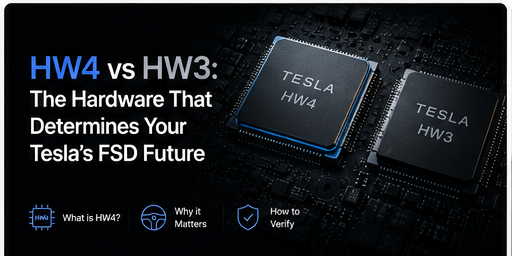
HW3 vs. HW4 — and why the year lies.
Hardware 3 (HW3) shipped from spring 2019 onward; cars built 2016 through early 2019 ran the older HW2/HW2.5. Hardware 4 (HW4) arrived on Model S/X in early 2023 and on Fremont-built Model Y around May 2023, then spread across the lineup. Every Cybertruck has been HW4 since its late-2023 launch — there is no HW3 Cybertruck.
The trap: HW3 and HW4 overlapped for well over a year, so the model year tells you nothing for certain. A 2023 or even 2024 Model Y can be either. Guessing by year is how people overpay. The only reliable answer is the car's actual AP_HARDWARE_VERSION record — which is exactly what UsedTesla.AI verifies per car, rather than inferring it from the build date.
What the difference means. Both HW3 and HW4 carry eight cameras; HW4's edge is higher-resolution cameras (~5MP vs ~1.2MP) and more compute, not more cameras. HW3 cars run today's Autopilot and Supervised Full Self-Driving fine. Where it matters: Tesla has stated HW3 cannot reach its unsupervised, next-generation self-driving — that's an HW4 capability. Tesla has, however, announced a reduced “v14 Lite” build for HW3 (features like Start from Park, reverse, and destination parking), targeted for mid-2026, though rollout timing can slip. Bottom line: if hands-off, unsupervised driving down the road is the goal, HW4 is the only path.
Reading battery health honestly.
Battery condition is the biggest swing in a used EV's value, because replacement out of warranty is brutal: roughly $13,000–$16,000 for a Model 3 or Y and about $20,000–$22,000 for a Model S or X (third-party or refurbished packs can run less).
Degradation is front-loaded, not linear. Teslas shed most of their capacity early, then level off — the opposite of the steady “2% a year forever” you'll hear repeated online. As a rough fleet baseline: about 95% capacity around 50,000 miles, ~88–90% by 150,000, and ~85–88% near 200,000 miles. So a high-mile car that's already flattened out can be a safer bet than its odometer suggests — and a one-year-old car showing 15% loss is the real red flag.
The five-minute check. Charge to 100% and read the estimated range on the screen, then compare it to the EPA figure for that exact trim. A car sitting well under spec — say, 15–20%+ below a comparable-age car — deserves a closer look, not an instant pass, since display range also shifts with settings and recent driving.
Go deeper if it matters. Ask for a recent State of Health (SoH) reading; if there isn't one, a Tesla Service Center can run a battery diagnostic. On the test drive, watch the energy graph (Wh/mi) and feel for weak acceleration or reduced regenerative braking — both soften when a pack is genuinely tired.
Mileage in context. Miles matter less than how the car was charged and cared for. A well-kept 90k-mile Tesla with strong SoH beats a neglected 40k-mile one. Judge the battery, not the odometer.
Accident History, Title Status, and Inspection
History and condition drive reliability, resale, and insurance — verify them before you commit, not after.
Pull the history. Run the 17-digit VIN (on the driver-side door jamb or lower windshield) through Carfax or AutoCheck. Tesla includes a free AutoCheck report on its own used listings. These show reported accidents, severity, and any salvage, rebuilt, or flood branding.
Where to draw the line. A salvage, rebuilt, or flood title is a hard no — it tanks resale and can void coverage. A clean-title car with a documented minor repair can be perfectly fine. UsedTesla.AI surfaces accident flags and clean-title status up front so a branded car never makes your shortlist.
Walk the car. Check panel gaps, paint texture, and door jambs for overspray (a tell of past bodywork). Inspect the charge port for damage or sketchy adapters, and look under the frunk for corrosion or loose parts. This is where unreported damage hides.
When in doubt, pay a pro. An independent EV or Tesla specialist pre-purchase inspection (roughly $150–$300) is cheap insurance against an expensive surprise.
Before you close, run the checklist:
- Pull the VIN history (Carfax/AutoCheck); confirm a clean title.
- Verify the Autopilot hardware version — HW3 vs HW4 — from the car's record, not its year.
- Charge to 100% and compare estimated range to EPA spec for the trim.
- On the test drive, check Wh/mi, acceleration, and regen.
- Get the original in-service date and current mileage to pin down remaining warranty.
- Ask for a State of Health reading, or budget a service-center diagnostic.
What the Warranty Actually Covers
Tesla's used coverage has two parts, and the valuable one isn't the headline bumper-to-bumper warranty — it's the battery.
Basic vehicle warranty. The original 4-year / 50,000-mile factory warranty transfers with the car. On the cars it sells, Tesla adds a 1-year / 10,000-mile Pre-Owned warranty on top of whatever's left. Third-party purchases inherit the remaining factory coverage but not that added year.
Battery & drive unit (the one that matters). This 8-year warranty transfers with the VIN to every subsequent owner — it is not original-owner-only, a point buyers routinely get wrong. It expires at 8 years or a mileage cap, whichever comes first:
| Model / trim | Mileage cap |
|---|---|
| Model S / X / Cybertruck | 150,000 mi |
| Model 3 / Y Long Range & Performance | 120,000 mi |
| Base RWD trims | 100,000 mi |
All of them also guarantee at least 70% battery capacity retention over the warranty period.
Why it's the most valuable line in the listing. With out-of-warranty replacement running roughly $13,000–$16,000 on a 3/Y and ~$20,000–$22,000 on an S/X, the remaining battery window is real money. A 60,000-mile car with years of battery coverage left carries far less tail risk than a 110,000-mile car about to age out. Get the in-service date and odometer, and you can price that risk exactly.
One more note: used Teslas are sold as-is. The old 7-day return policy ended in 2020, so there's no buyer's-remorse window — inspect before you buy.
Which Software Perks Transfer (and Which Don't)
Subscriptions and licenses don't all follow the car. Knowing what you're actually inheriting is the difference between a deal and a disappointment.
Full Self-Driving. An FSD license is tied to the VIN, so on a third-party or private sale it stays with the car. The exception is Tesla itself: if Tesla re-acquired the car as a trade-in, it can remove FSD before relisting — so a Tesla-sold car has FSD only if the listing says so. Verify either way (Controls > Software on the touchscreen). Worth knowing: Tesla discontinued the one-time FSD purchase in early 2026, so if a used car doesn't already include the license, your only route now is the $99/month subscription — another reason an FSD-equipped car can be worth paying up for.
Premium Connectivity. A handful of early cars carry lifetime Premium Connectivity that transfers: Model S/X ordered on or before Jan 9, 2020; Model 3/Y on or before Aug 29, 2019; any Tesla on or before Jun 30, 2018. Outside those windows it's a subscription — $9.99/month or $99/year — and new owners typically get a short free trial before billing starts. Standard Connectivity (basic maps/navigation) stays free. Don't assume; confirm the car's status with the seller.
Free Supercharging. Genuinely transferable free Supercharging is now rare — mostly limited to certain pre-2017 cars. Most free-charging promotions since then are tied to the original owner and don't transfer, and Tesla strips the benefit on any car it re-acquires. Treat it as a bonus only if it's confirmed in writing — never pay a premium expecting it.
Protect yourself. Before money changes hands, get a screenshot of the Tesla app showing FSD and Premium Connectivity status, and written confirmation of any benefit the seller claims transfers.
Delivery Fees, Total Cost, and Incentives
The sticker isn't the price. On Tesla.com, distance adds a transport fee; everywhere, taxes and registration apply. Here's how to get to the real out-the-door number.
Tesla's transport fee. Tesla charges a non-refundable transport fee, which it states runs $500 to $2,500 by distance, with free pickup at a local Tesla location. There's no published distance-tier table, and it's due at order. (Note: the ~$1,390 destination & documentation fee you'll see quoted is a new-car charge — it does not apply to used cars.) Listings tend to surface nearby cars first, with the fee climbing as you widen the search.
The deposit. A used order takes a $500 deposit, refundable only if Tesla financing is denied or you switch to a new-car order — otherwise it's non-refundable once placed. Be reasonably sure before you commit.
Add the rest. The transport fee covers shipping only — not your state's sales tax, registration, or doc fees. Factor those in before comparing cars. A car 1,000 miles away can still beat a local one once you net out everyone's margins. UsedTesla.AI shows the all-in price with the real distance-based delivery fee, so you're comparing true costs, not sticker prices.
Federal used-EV credit — gone for 2026. The up-to-$4,000 used clean vehicle credit (IRC §25E) was ended early by the 2025 budget law and does not apply to any vehicle acquired after September 30, 2025. There is no federal used-EV credit for the 2026 tax year. Bought a qualifying used EV on or before that date? Ask a tax pro about claiming it. Otherwise, plan on state and local programs only.
State incentives (verify current amounts). These change with funding and legislation, so treat the below as where to look, not guaranteed dollars:
- California: Clean Cars 4 All offers used-EV rebates for income-qualifying buyers (and often charger or transit support). Check the CARB site for current eligibility.
- Colorado: State credits for qualifying used EVs, plus a Vehicle Exchange point-of-sale rebate for trading up from an older car. Check the Colorado Energy Office.
- New York: Drive Clean and home-charger rebates — confirm details with NYSERDA / the state environmental site.
- Elsewhere: Programs vary widely; check your state energy or environmental office.
Some rebates are point-of-sale; others require filing after purchase. Confirm the mechanics with the program — and your accountant — before closing.
Skip the Guesswork with UsedTesla.AI
Every checkpoint above — hardware, history, all-in price — is a place to overpay or get burned if you eyeball it. UsedTesla.AI is an independent search front-end over Tesla.com's own used inventory (we're not affiliated with Tesla) that nails down the facts for you.
What we verify per car: Autopilot hardware read straight from Tesla's AP_HARDWARE_VERSION record — never guessed from the model year — plus clear accident and clean-title flags, the true all-in price including the real distance-based delivery fee to your ZIP, and remaining warranty context.
Free to browse; $29 for alerts. Search the entire used inventory for free. A one-time $29, 60-day alert pass watches for cars matching your exact criteria — model, year, hardware version, price, mileage, accident-free — and pings you the moment one lists, before it's gone. It comes with a 7-day money-back guarantee. We earn a small referral fee when you buy through Tesla; you pay Tesla the same price either way.
Next step: Browse the live inventory, filter to what matters to you, and set an alert so the right car finds you instead of the other way around.
Frequently asked questions
Can I tell if a used Tesla has HW3 or HW4 from the model year?
No. HW4 rolled out starting in early 2023 (Model S/X) and around May 2023 on Fremont Model Y, but HW3 and HW4 overlapped well into 2024. A 2023 or 2024 Model Y can be either. The only reliable answer is the car's actual AP_HARDWARE_VERSION record — which UsedTesla.AI verifies per car — not a guess from the year.
Will Full Self-Driving transfer when I buy a used Tesla?
An FSD license is tied to the VIN, so on a private or third-party sale it stays with the car. The exception is Tesla itself: if Tesla re-acquired the car as a trade-in, it can remove FSD before reselling, so a Tesla-sold car has it only if the listing says so. Verify under Controls > Software. Note that Tesla ended one-time FSD purchases in early 2026, so otherwise the only way to add it is the $99/month subscription.
How much battery degradation should I expect on a used Tesla?
Degradation is front-loaded, not a steady 2% a year. As a rough fleet baseline, expect around 95% of original capacity near 50,000 miles, ~88–90% by 150,000, and ~85–88% near 200,000 miles. The real warning sign is a young, low-mileage car already showing heavy loss. Ask for a State of Health reading, or charge to 100% and compare the displayed range to the EPA figure for that trim.
Is there a federal tax credit for a used Tesla in 2026?
No. The up-to-$4,000 used clean vehicle credit (IRC §25E) was ended early by the 2025 budget law and doesn't apply to vehicles acquired after September 30, 2025. There's no federal used-EV credit for the 2026 tax year. Some state programs (California, Colorado, New York and others) still offer used-EV rebates — check your state, since amounts and eligibility change.
How much will delivery cost if I buy a used Tesla on Tesla.com?
Tesla charges a non-refundable transport fee that it states runs $500 to $2,500 by distance, with free pickup at a local Tesla location, due at order. There's no published distance-tier table. UsedTesla.AI shows the all-in price including the estimated delivery fee so you see the true cost before you commit.
What does the warranty cover on a used Tesla?
The original 4-year / 50,000-mile basic warranty transfers, and on cars it sells Tesla adds a 1-year / 10,000-mile Pre-Owned warranty on top. The most valuable piece is the 8-year battery & drive unit warranty, which transfers with the VIN to any owner (not original-owner-only). Mileage caps: 150,000 mi for Model S/X/Cybertruck, 120,000 for Long Range/Performance 3 and Y, 100,000 for base RWD — all guaranteeing at least 70% capacity retention. Out-of-warranty battery replacement runs roughly $13,000–$16,000 on a 3/Y and ~$20,000–$22,000 on an S/X, which is what makes that coverage matter.
Ready to find yours? Verified hardware, true all-in pricing, clean-history only.
Browse used Teslas →Keep reading