Average Used Tesla Prices in 2026: Live Market Data by Model, Hardware & Mileage

A used Model 3 and a used Model Y can carry nearly the same odometer reading and sit $10,000 apart, and the gap often comes down to one thing you can't see in the photos: which self-driving computer is inside. We pulled 2,013 active listings from Tesla's own US pre-owned inventory in June 2026 and broke them down by model, hardware generation, mileage, and age. UsedTesla.AI is an independent search front-end over that same Tesla.com inventory—we're not affiliated with Tesla—so the numbers below are real asking prices, not estimates. Here's what a fair deal actually looks like right now.
Find your match, then never miss it.
Browse every used Tesla in the US free, or set a $29 alert and we ping you the moment your car appears or drops in price.
Used Tesla Pricing Overview (June 2026)
The whole used Tesla market in one snapshot, as of June 2026:
| Model | Avg Price | Median Price | Price Range | Listings |
|---|---|---|---|---|
| Model Y | $38,312 | $35,600 | $23,900–$58,490 | 853 |
| Model 3 | $35,279 | $33,400 | $18,900–$54,990 | 819 |
| Model S | $56,244 | $56,300 | $23,200–$80,700 | 167 |
| Model X | $61,158 | $63,000 | $32,000–$85,700 | 166 |
| Cybertruck | $98,130 | $100,990 | $85,490–$106,490 | 8 |
| All Used Teslas | $40,687 | $36,900 | $18,900–$106,490 | 2,013 |
Two cars carry the market: Model 3 and Model Y together are 83% of all listings. The Y averages a bit more than the 3 ($38.3K vs. $35.3K) because the used Y fleet skews newer, not because it holds value better per year. Model S, X, and Cybertruck make up the premium tier, and Cybertruck supply is still a rounding error—just 8 cars nationwide. Watch the median, not the average: a handful of pricey outliers pull every average upward, so the median is the truer picture of what you'll actually pay.
Hardware Matters: HW3 vs. HW4 & What It Means for Price
The computer behind the dash is the single biggest invisible variable in a used Tesla's price. Here's what's worth knowing.
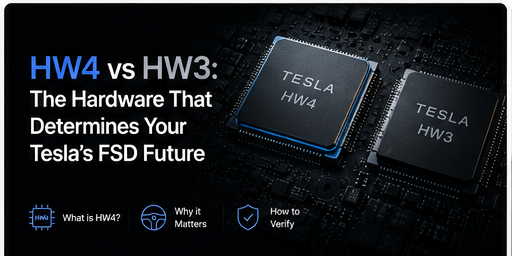
Hardware 3 (HW3): Shipped from spring 2019 onward. It runs supervised Autopilot—lane centering, traffic-aware cruise, auto lane change—but Tesla has said it cannot reach the unsupervised, next-generation Full Self-Driving built for newer cars. That said, HW3 isn't frozen: Tesla has announced a cut-down “FSD v14 Lite” for HW3 (Start from Park, reverse, parking-destination options), with the US rollout targeted for around mid-2026. It stays a hands-on, Level 2 system, and Tesla's timelines do slip—treat it as a bonus, not a guarantee.
Hardware 4 (HW4): More compute and higher-resolution cameras (roughly 5MP vs. HW3's ~1.2MP). Note that both generations use eight cameras; HW4's edge is resolution and processing, not camera count. HW4 gets the newest FSD builds first and is the path to future autonomous features. It reached Model S/X in early 2023 and Fremont-built Model Y around May 2023, then spread through 2024. Every Cybertruck is HW4.
The price gap in our data:
- Model 3: HW4 averages $39,038 vs. $28,117 for HW3, about $10,900 more (39%)
- Model Y: HW4 averages $39,062 vs. $33,008 for HW3, about $6,000 more (18%)
The trap: you cannot tell HW3 from HW4 by model year—the two overlapped through 2023 and into 2024. UsedTesla.AI reads each car's AP_HARDWARE_VERSION straight from Tesla's per-car record, so the badge you see is verified, not guessed from the build date. Takeaway: a $6–11K premium for HW4 pays off if you'll keep the car 5+ years and want the newest software, but only if the car you're buying is actually HW4. Confirm it.
Model 3, Y, S, X & Cybertruck: By the Numbers
Model 3 ($35,279 avg, $33,400 median): The cheapest way into a Tesla, with the widest selection at 819 listings. Half the market sits below $33.4K. The ~$36K spread is mostly hardware and age: a high-mileage HW3 car can dip under $20K, while a newer HW4 example pushes toward $55K. Decide your hardware first, then shop the price.
Model Y ($38,312 avg, $35,600 median): The volume leader at 853 listings. It runs higher than the 3 because the used Y fleet is simply newer, not because it holds value better per year. For most buyers the $35.6K median is the sweet spot—more space and a newer build than a Model 3 at the same money.
Model S ($56,244 avg, $56,300 median) & Model X ($61,158 avg, $63,000 median): The luxury tier. The X carries about $5K over the S for its size and seating. Both ranges are huge because the fleet spans many model years—a median Model S near $56K is typically 5–8 years old with 50K–100K miles. Out-of-warranty repairs here aren't cheap (a Model S/X battery, if it ever needs replacing, runs roughly $20,000–$22,000), so weigh remaining warranty and service history hard. Note: Tesla wound down Model S production in 2026, which thins future used supply.
Cybertruck ($98,130 avg, $100,990 median, 8 listings): Barely a used market yet. Tight pricing, most under 10K miles, supply still locked up. Expect to pay near new-car money.
Mileage, Age, Delivery Fees & What to Expect
How price tracks miles and years (rough guide):
- 0–50K mi (0–3 yrs): ~65–75% of original price
- 50K–100K mi (3–5 yrs): ~50–65%, often the value sweet spot
- 100K–150K mi (5–7 yrs): ~40–55%
- 150K+ mi (7+ yrs): ~25–40%
These are directional, not promises—hardware, trim, and condition move a given car well off the curve.
Battery durability: This is where used Teslas earn their reputation. Tesla's own fleet data and independent studies put capacity loss at roughly 12–15% over 200,000 miles, so a typical car still holds around 88–90% at 150K miles. Degradation is front-loaded—a few percent in the first year or two, then a long, gentle slope. Still, always pull the car's battery-health and range data before buying; a single mistreated pack can buck the average.
Delivery fees: Tesla states a non-refundable transport fee of $500–$2,500 based on distance, with free pickup at a local Tesla location. There's no published distance-tier table, and this fee is separate from the new-car destination & documentation fee—don't let anyone apply a four-figure “doc fee” to a used car. UsedTesla.AI estimates this into the all-in price so the number you compare is what you'll actually pay. Example: a $35,600 Model Y plus a mid-range transport fee (say ~$1,200) is roughly $36,800 out the door, or $35,600 if you pick it up locally.
Accident & title history: A salvage, rebuilt, or branded title is a hard pass—it can wipe 30–50% off value and signals worse. A prior repaired accident on an otherwise clean title isn't automatically disqualifying, but it should move the price. UsedTesla.AI flags accident history and clean-title status on each listing so you're not negotiating blind.
How to Find the Best Deal & Why Setting an Alert Matters
1. Anchor to the median. Model Y sits at $35.6K, Model 3 at $33.4K. A 2–3 year old Model Y with ~60K miles and verified HW4 around $38K is fair. The same car at $45K with 80K miles on HW3 is not—walk.
2. Verify hardware before you commit. Don't guess HW3 vs. HW4 by year; they overlapped for two model years. Get the AP_HARDWARE_VERSION confirmed—a $6–11K swing is too big to assume.
3. Sanity-check miles and age against the range. The Model Y band is $23.9K–$58.5K. A 2-year-old at 35K miles belongs near the top; a 7-year-old at 140K near the bottom.
4. Move quickly on the good ones. Sub-$30K Model 3s and low-mileage HW4 Model Ys under $35K tend to sell within days. Tesla's used inventory turns fast.
5. Let an alert do the watching. Tesla's pre-owned inventory is public and changes constantly, but refreshing it by hand is a losing game. UsedTesla.AI's alerts ping you the moment a car matches your model, hardware, mileage, and budget—with the verified HW badge and all-in price already attached, so you can judge it in seconds instead of racing to check.
Where to Buy: Tesla Pre-Owned vs. Private vs. Dealerships
Tesla.com pre-owned: The most transparent option, and the source behind our snapshot. Each car lists price, mileage, Autopilot hardware, and known defects, and passes a 102-point inspection. Coverage is the balance of the original 4-year/50,000-mile basic warranty plus an added 1-year/10,000-mile used warranty, and the 8-year battery & drive-unit warranty transfers with the VIN to you. Used cars sell as-is—there's no return window (Tesla's 7-day return ended in 2020). A $500–$2,500 transport fee applies unless you pick up locally.
Private sellers: Often 10–20% below Tesla's prices, but you take on inspection, history verification, and negotiation yourself. The factory battery warranty still transfers, but there's no added used coverage.
Third-party dealerships: May bundle financing or aftermarket warranties, but frequently mark up 15–30% over fair market. Any “certified” coverage is the dealer's own, not Tesla's—read what actually transfers before you pay for it.
Whichever route you take, the median is your leverage. Knowing that the middle of the Model Y market is $35.6K turns a negotiation into a fact-check.
Key Takeaways & What Happens Next
Bottom line: Used Tesla prices have largely settled in 2026. Model 3 and Y are the value play ($33–38K median), Model S/X are the luxury tier ($56–63K median), and the Cybertruck is barely a used market yet (~$99–101K). HW4 commands $6–11K over HW3 in our data because HW3 won't reach the next-generation unsupervised FSD, though Tesla's v14 Lite still brings real features to older cars. Within a single model, hardware, mileage, and age swing the price far more than buyers expect.
Avoid the common mistakes: don't infer hardware from model year, don't forget the $500–$2,500 transport fee, don't skip the battery-health check, and don't treat a salvage or rebuilt title as a discount—it's a walk-away. And don't dawdle on a car that fits; the good ones go in days.
Next step: Set an alert on UsedTesla.AI for your model, hardware (HW3 or HW4), mileage, and budget. Browsing is free; we read the verified hardware from Tesla's per-car record, show the true all-in price, and flag accident history, so when a match lands you already know it's real.
Frequently asked questions
What's the difference between HW3 and HW4, and why does HW4 cost $6K–11K more?
HW4 is Tesla's newer self-driving computer, with more compute and higher-resolution cameras. Both generations use eight cameras, so HW4's edge is resolution (~5MP vs ~1.2MP) and processing, not camera count. HW3 runs supervised Autopilot but, per Tesla, can't reach the next-generation unsupervised Full Self-Driving; it does get a cut-down ‘v14 Lite’ build, with the US rollout targeted around mid-2026. That capability gap is what the price premium reflects. Crucially, you can't tell them apart by model year—they overlapped through 2023–2024—so verify the car's AP_HARDWARE_VERSION before buying. UsedTesla.AI reads that record directly.
Why does the Model Y price range so widely ($23.9K–$58.5K)?
Age, mileage, hardware, and condition all stack up. A car near $58.5K is typically a recent HW4 build under 30K miles with a clean title; one near $23.9K is usually an older, high-mileage HW3 example. Use the median ($35.6K) as your anchor, then adjust up or down for the specific miles, age, and hardware you want.
How much will delivery actually cost?
Tesla states a non-refundable transport fee of $500–$2,500 based on distance, paid at order time, with free pickup at a local Tesla location. There's no published distance-tier table, and it's separate from the new-car destination & documentation fee—so a used car shouldn't carry a four-figure 'doc fee.' On a $35K Model Y that's roughly $35.5K–$37.5K all-in, or $35K flat if you pick it up locally.
Are used Tesla batteries reliable, and how do I check battery health?
Generally yes. Tesla's fleet data and independent studies show roughly 12–15% capacity loss over 200,000 miles, so most cars still hold around 88–90% at 150K miles, with degradation front-loaded then flattening. The original 8-year battery & drive-unit warranty transfers with the VIN. Before buying, pull the car's range and battery-health data plus full service history; one mistreated pack can underperform the average.
Should I buy from Tesla pre-owned, a private seller, or a dealership?
Tesla pre-owned is the most transparent: listed hardware and defects, a 102-point inspection, the remaining 4yr/50k basic warranty, an added 1yr/10k used warranty, and the transferable 8-year battery warranty, with a $500–$2,500 transport fee. Private sellers run 10–20% cheaper but put inspection and history on you. Third-party dealers may add warranties but often mark up 15–30%, and any 'certified' coverage is theirs, not Tesla's. Whichever you choose, check accident and title history first—that part isn't optional.
When's the best time to buy—are prices falling or rising?
Prices have largely stabilized in 2026 after the 2024–2025 swings, drifting only slightly for older inventory. There's no big drop worth waiting for. If a car fits your specs and the price is fair against the median, buy it—the best deals (sub-$30K Model 3s, low-mileage HW4 Model Ys under $35K) sell within days. Speed beats timing.
Ready to find yours? Verified hardware, true all-in pricing, clean-history only.
Browse used Teslas →Keep reading