Tesla Model Y vs Model 3: How to Decide Between Two Great Used EVs
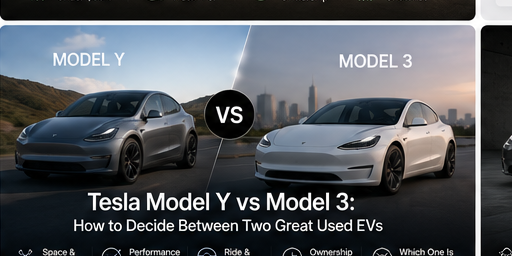
The Model 3 and Model Y share a platform, a battery architecture, and most of their parts bin—so on a spec sheet they look like the same car in two costumes. They aren't. One is a low, quick sedan; the other is a taller hatch with room for a stroller and a Costco run. The used-market price gap between them is real but smaller than people assume, and the right pick comes down to a few concrete questions about how you actually live.
This guide skips the brochure language and walks the differences that change a buying decision—cargo, seating, ride height, range, efficiency, and used pricing—so you can decide before you set an alert at UsedTesla.AI.
Find your match, then never miss it.
Browse every used Tesla in the US free, or set a $29 alert and we ping you the moment your car appears or drops in price.
Shared Platform, Different Bodies
Start with the bones: the Model Y is built on the Model 3 platform and shares its battery architecture and most structural hardware. That overlap is exactly why parts, repairs, and charging behavior feel familiar across both, and why Tesla can build them cheaply side by side.
The body is where they split. The Model 3 is a low, aerodynamic sedan; the Model Y is a compact crossover with a tall roofline, a hatchback opening, and a higher seating position. Comparing the current cars, the Model Y is roughly 2 inches wider, about 7 inches taller, and a few inches longer than the Model 3, and it weighs a few hundred pounds more (around 370 lb comparing Long Range AWD trims). Figures shift slightly by model year and refresh. The practical upshot: don't assume driving one tells you how the other feels. Test drive both.
Cargo, Seating, and Headroom: Where Practicality Diverges
Cargo. This is the biggest real-world gap. The Model Y holds roughly 30 cubic feet behind the second row, expanding to about 72 cubic feet with those seats folded; add the front trunk and Tesla's headline total lands near 76 cubic feet. The Model 3 sedan offers 22.9 cubic feet of trunk space, or roughly 24–26 cubic feet total with the frunk. If you regularly haul groceries, gear, luggage, or a dog, the Model Y's hatch and folding seats are the difference between fitting it and not.
Seating & headroom. Both seat five as standard. The Model Y gives you about 41.0 inches of front headroom and 39.4 inches in the second row—noticeably airier than the lower-slung Model 3 (roughly 40.3 and 37.7 inches), which makes the Y the more comfortable choice for tall passengers on long drives.
The third-row question. Some Model Y configurations add a third row, but be honest about what it is: with roughly 34.6 inches of headroom and 26.5 inches of legroom, it's a kids-or-emergencies bench, not adult seating. Anyone over about 5′6″ will be cramped within minutes. Treat it as occasional carpool overflow, not a reason to skip a minivan if you genuinely need three rows.
Ride Height, Ground Clearance, and Driving Character
Ground clearance. The Model Y has 6.6 inches versus the Model 3's 5.5 inches—a 1.1-inch edge that earns its keep on steep driveways, rough roads, gravel, and packed snow.
Seating position. The Model Y sits higher and mounts its seats higher, giving a more upright, commanding view that many drivers find less tiring in traffic and easier to get in and out of. The Model 3 sits low and sporty: great for spirited driving, less so if you're hauling yourself out of it dozens of times a day.
How they drive. The Model 3 is the more engaging car—lower center of gravity, less weight, tighter handling, quicker reflexes. The Model Y trades some of that sharpness for visibility and versatility. Neither is wrong; they're tuned for different drivers. If you want a car that's fun to throw at an on-ramp, it's the 3. If you want command and space, it's the Y.
Range, Efficiency, and Real-World Performance
Efficiency. The Model 3 is marginally more efficient, but the gap is small enough to be a tiebreaker at most. The current Model 3 Standard RWD is rated about 139 MPGe combined; the Model Y Standard RWD about 138 MPGe—essentially a wash, with the lighter, slipperier Model 3 holding a narrow edge. In real-world terms that's roughly 250 Wh/mile for the Model 3 versus 270 Wh/mile for the Model Y.
EPA range. The 2026 Model 3 reaches up to 363 miles (Premium RWD); the Model Y RWD runs from 321 miles (Standard) to 357 miles (Long Range RWD). Expect to fall a bit short of these numbers at sustained highway speeds and in cold weather—EPA figures reflect a mixed cycle, not a steady 75 mph cruise, and EVs typically trail their rating on the open road.
What it costs you. Both easily cover a 200-mile weekend on one charge. The Model 3's efficiency edge works out to only about $30–40 a year in electricity over the Model Y at 10,000 miles—negligible for most buyers. Pick on space and feel, not the power bill.
Used Pricing, Delivery Fees, and Warranty
Used pricing. A 2022 Model 3 Long Range generally runs around $22,000–$28,000; a comparable 2022 Model Y Long Range around $27,000–$32,000. These are approximate ranges that move with mileage, condition, region, and supply. The roughly $5,000 premium for the Y holds up on newer cars but compresses on older ones (2019–2021), where comparable 3s and Ys often sit within a few thousand dollars of each other.
Delivery fees. Used Teslas carry a non-refundable transport fee that Tesla states runs about $500 to $2,500 depending on distance, with free local pickup. Don't confuse this with the $1,390 destination & documentation fee, which applies to new cars only—it doesn't belong on a used quote. Always confirm the true all-in price, delivery included, before you commit.
Warranty. Used Teslas pass a 102-point inspection and carry any remaining 4-year/50,000-mile Basic warranty plus an added 1-year/10,000-mile used-vehicle warranty. The separate 8-year Battery & Drive Unit warranty transfers with the VIN to you as a subsequent owner—it is not original-owner-only—though mileage caps vary by model (120,000 miles on Model 3/Y Premium and Performance, 100,000 on base RWD). Note there's no return window: Tesla's 7-day return policy ended in 2020, and used cars are sold as-is. Verify the current terms on Tesla's used-warranty page before you buy.
Model 3 vs Model Y: Who Each Is Actually For
Lean Model 3 if you drive solo or as a couple, care about handling and efficiency, park somewhere tight, or simply want to spend a few thousand less for a comparable year and mileage. It's the commuter's and enthusiast's pick.
Lean Model Y if you have kids or pets, haul cargo or gear, want a higher seating position and better visibility, deal with snow or rough roads, or value hatchback flexibility over sedan polish. It's the family and do-it-all pick.
Strip away the spec sheets and it's one question: do you need the space and ride height, or would you rather have the lower, sharper, cheaper car? Both are excellent. A back-to-back test drive settles it faster than any chart.
Finding Your Match at UsedTesla.AI
So: the Model 3 is the efficient, lower-cost sedan for solo drivers and couples; the Model Y is the roomier, taller crossover for families and haulers. Once you know which, the job is finding the right one at the right price before someone else does.
UsedTesla.AI is an independent search front-end over Tesla's own used inventory—we're not affiliated with Tesla. What you get: true all-in pricing that folds in the distance-based delivery fee, so the number you see is the number you'd pay. Hardware verified from Tesla's per-car AP_HARDWARE_VERSION record—real HW3-vs-HW4 confirmation, not a guess from the model year (it matters for future Full Self-Driving; see our HW4 guide). And accident and clean-title flags so you know a car's history before you drive to it.
Browsing is free. If you want to be first to a match, a one-time $29 60-day alert pass (not a subscription—one payment, two months, 7-day money-back) pings you the moment a car fitting your criteria hits inventory. You pay Tesla their normal price; we earn a small referral fee. Start your search and set an alert—in this market, the right car at the right price doesn't sit for long.
Frequently asked questions
Does the Model Y really hold far more than the Model 3?
Yes. The Model Y offers roughly 76 cubic feet of total cargo space with the rear seats folded (including the frunk), versus about 24–26 cubic feet total for the Model 3. The hatchback opening and folding seats make the Y dramatically more useful for bulky loads, even if the seats-up gap is smaller than the headline number suggests.
Can adults sit in the Model Y's third row?
Only shorter adults, and only briefly. With about 26.5 inches of legroom and 34.6 inches of headroom, anyone over roughly 5′6″ will be knees-up and cramped. It's built for kids or short emergency trips, not daily adult seating. If you genuinely need three usable rows, look beyond the Model Y.
How much more efficient is the Model 3 than the Model Y?
Barely. The Model 3 Standard RWD is rated about 139 MPGe versus 138 MPGe for the Model Y Standard RWD—roughly 20 Wh/mile better in real-world use. Over 10,000 miles that's only about $30–40 in electricity savings a year. It's a rounding error for most buyers.
Will I pay much more for a used Model Y than a used Model 3?
Usually a few thousand more for a comparable year and mileage—often around $5,000 on 2022 cars (a 2022 Model 3 Long Range runs roughly $22,000–$28,000; a 2022 Model Y Long Range roughly $27,000–$32,000). The gap narrows on older 2019–2021 cars. All ranges shift with market, region, and supply.
What delivery fee should I expect on a used Tesla?
Tesla states a non-refundable transport fee of roughly $500 to $2,500 depending on distance, with free local pickup. Don't confuse it with the $1,390 destination fee, which applies to new cars only. Always confirm the true all-in price—delivery included—before placing an order.
Does the used battery warranty transfer to me?
Yes. The 8-year Battery & Drive Unit warranty transfers with the VIN to subsequent owners; it is not original-owner-only. Mileage caps vary by model (for example, 120,000 miles on Model 3/Y Premium and Performance, 100,000 on base RWD). Used cars also keep any remaining 4-year/50,000-mile Basic warranty plus an added 1-year/10,000-mile used warranty. There's no return window—cars are sold as-is.
Ready to find yours? Verified hardware, true all-in pricing, clean-history only.
Browse used Teslas →Keep reading