Used Tesla Model 3 vs Model S: How to Decide
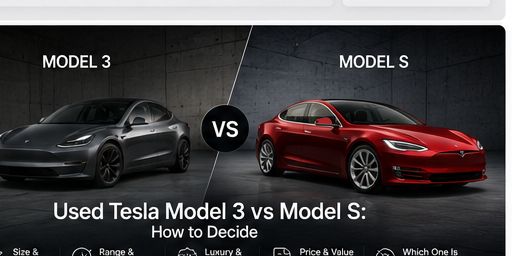
Here's the short version: a used Model 3 gives you most of the Tesla experience for roughly half the money. The Model S buys you a hatchback you can actually load, an air ride that smooths broken pavement, and more highway range. Everything below is about whether that gap is worth it for you.
One piece of timing matters. Tesla wound down Model S production in 2026 (custom orders closed around April), so used Model S inventory only gets thinner from here. The Model 3 is still in full production, so supply and pricing stay steadier. That shapes your buying window more than any spec sheet does.
Find your match, then never miss it.
Browse every used Tesla in the US free, or set a $29 alert and we ping you the moment your car appears or drops in price.
Size, Space, and Cargo: Which Fits Your Lifestyle
Interior passenger room is close between the two. The real difference is the tailgate: the Model S is a liftback, the Model 3 is a conventional sedan with a sealed trunk lid. That single design choice drives most of the practical gap.
Footprint: The Model 3 is about 4,720 mm long and 1,850 mm wide. The Model S is roughly 5,021 mm long and 1,987 mm wide—noticeably bigger in a parking garage, with a lower roofline that trades a little headroom for aerodynamics.
Cargo, where it counts: The Model 3 offers about 24 cu ft of total cargo with the seats up, expanding to roughly 34–35 cu ft folded, plus a 3.1 cu ft frunk. The Model S has about 25 cu ft behind the rear seats but opens up to roughly 61 cu ft folded, plus a similar ~3.1 cu ft frunk. The numbers behind the seats look close; the difference is that the Model S's tall, wide hatch swallows bikes, flat-pack furniture, and luggage the Model 3's sedan opening simply can't.
Seating: Both seat five adults comfortably. You may see old listings mention rear-facing “jump seats”—that was a rare early-Model-S option for small children, long since discontinued, and the refreshed (2021+) cars don't offer it. Treat both as five-seaters.
Takeaway: If you regularly haul gear or do family road trips, the Model S hatchback is the deciding feature. If your cargo is groceries and the occasional suitcase, the Model 3 is plenty.
Range, Performance, and Ride Quality: The Daily Feel
Range (EPA): The 2026 Model 3 is rated up to 363 miles for rear-wheel drive and about 346 miles for the dual-motor Premium AWD. The Model S Long Range is rated 410 miles. That's roughly 50–65 miles of real advantage—meaningful on long highway days, irrelevant if you charge at home and rarely top 200 miles a week. One honest caveat: EVs usually fall a bit short of EPA on the highway and in the cold, so plan around real-world numbers, not the sticker.
Acceleration: The Model 3 Performance makes 510 hp and does 0–60 in roughly 2.9 seconds; the Premium Long Range AWD does it in about 4.2 seconds. The Model S Plaid is a tri-motor monster—Tesla quotes 1.99 seconds 0–60 with rollout (the drag-strip method that starts the clock around 6 mph); independent tests without that adjustment land closer to 2.3 seconds. The base Model S Long Range is around 3.1 seconds. Bottom line: any of these is faster than you need, and a Model 3 Performance will out-drag most Model S trims short of the Plaid.
Ride and refinement: The Model 3 uses a coil-spring suspension tuned firm—tight and fun, but it can feel busy on rough pavement. The Model S rides on adaptive air suspension that lowers at speed and soaks up bumps, paired with thicker glass and better sound insulation. The cabins reflect the price gap: the Model 3 is clean and minimal with a lot of hard plastic; the Model S adds softer materials, ventilated seats, and a quieter ride.
Takeaway: Long commutes and road trips lean Model S. If you want a sharp, sporty daily and don't mind firmer pavement feedback, the Model 3 is the more engaging car.
Technology: Hardware, Software, and Future Capability
Screens: The Model 3 has a 15.4-inch center touchscreen; the Model S has a 17-inch display that pivots between landscape and portrait. On long drives the bigger screen is genuinely easier to read, but both run the same software.
Computer (MCU): Most used cars you'll see run either MCU2 (Intel Atom—fine, just a step slower) or MCU3 (AMD Ryzen—snappier UI, smoother visuals, in-car gaming). MCU3 arrived with the refreshed Model S in 2021 and on the Model 3 around 2022. It's a nice-to-have, not a make-or-break.
Autopilot hardware—this is the one that matters (HW3 vs. HW4): Both HW3 and HW4 use eight cameras; HW4's edge is higher-resolution cameras (~5MP vs ~1.2MP) and more compute, not more cameras. The catch: HW3 cannot run Tesla's next-generation unsupervised FSD, and it can't be upgraded to HW4 in place. Tesla has said HW3 cars will get a trimmed FSD v14 “Lite” (features like Start from Park and destination parking), targeted for mid-2026—real, but timing can slip. HW4 began shipping on the Model S/X in early 2023 and on Fremont-built cars around May 2023. So most pre-2023 cars are HW3 and many 2023+ cars are HW4—but year is a guess, not proof. UsedTesla.ai reads each car's actual AP_HARDWARE_VERSION record from Tesla, so you get the real answer per VIN.
Takeaway: If your goal is the latest features and a path toward future autonomy, prioritize a HW4 car. If you mainly want today's supervised Autopilot, HW3 still does that well—just buy it with eyes open about the FSD ceiling.
Used Pricing and Value: Which Costs Less Long-Term
Where the markets sit (mid-2026): Used Model 3s broadly run from the low-$20,000s to mid-$30,000s depending on year, trim, and miles. Used Model S prices generally start around $50,000–$60,000 for a Long Range and climb past $80,000 for clean Plaids. Specific listings vary a lot by condition—treat these as ballparks, not quotes.
The real gap: A typical used Model 3 Long Range lands around $25,000–$30,000 all-in; a comparable Model S starts near $50,000. Call it roughly 2x for similar age and mileage. That premium buys a bigger hatchback, more range, air suspension, and a plusher interior—but not meaningfully more tech or everyday speed.
Depreciation: The Model 3 has held up well—recent data puts three-year retention around 61–65%, dropping into the high-40s/50s for higher-mileage cars. The Model S has depreciated faster in recent years as competition grew and production wound down; with inventory now shrinking, used Model S prices may firm up, but that path is harder to predict than the Model 3's steadier curve.
No federal tax help anymore: The federal used-EV credit (up to $4,000) ended for vehicles acquired after September 30, 2025—there's no federal used-EV credit for the 2026 tax year. Some state or utility incentives may still apply where you live, but budget on the sticker plus delivery, not on a federal credit.
Delivery and deposit: Tesla charges a non-refundable transport fee of $500–$2,500 by distance for used cars, with free local pickup; there's no published distance-tier table, so the only reliable number is the one on the car you're looking at. (Ignore the ~$1,390 figure you may see quoted—that's the new-car destination & doc fee and doesn't apply to used.) The order deposit is $500, refundable only if Tesla financing is denied or you switch to a new-car order, and otherwise non-refundable once you've placed the order.
Takeaway: If budget leads, the Model 3 is the obvious value—most of the capability at half the cost. If space, ride, and range are non-negotiable and the budget's there, the Model S premium is defensible—just don't wait too long, because the supply is only tightening.
Who Should Buy Model 3 vs. Model S
Lean Model 3 if you:
- Want a modern EV near or under $30,000.
- Drive mostly local or predictable routes and charge at home.
- Prize efficiency and low running costs over plushness.
- Are one or two people, or a small family without big cargo needs.
- Enjoy a tight, sporty feel more than a floaty one.
- Want the steadier resale story for long-term ownership.
Lean Model S if you:
- Have ~$50,000+ and want space and refinement.
- Road-trip often or live far from fast charging.
- Regularly haul bikes, gear, or bulky loads and need the hatchback.
- Want the smoothest, quietest ride of the two.
- Value a more premium cabin and adaptive air suspension.
- Can act soon, given shrinking post-production inventory.
Takeaway: Most buyers are well served by a Model 3. The Model S earns its premium for haulers, frequent long-haulers, and comfort-first drivers—not for outright speed or tech.
Key Specs at a Glance: Quick Comparison
| Spec | Model 3 Long Range AWD | Model S Long Range |
|---|---|---|
| Length | ~4,720 mm | ~5,021 mm |
| Cargo (seats up / folded) | ~24 cu ft / 34–35 cu ft | ~25 cu ft / ~61 cu ft |
| Frunk | ~3.1 cu ft | ~3.1 cu ft |
| EPA Range | ~346 miles | 410 miles |
| 0–60 mph | ~4.2 sec | ~3.1 sec |
| Suspension | Coil spring (sport) | Adaptive air (comfort) |
| Display | 15.4 in | 17 in |
| Interior | Modern, minimal | Premium, refined |
| Used price (mid-2026) | ~$25,000–$30,000 | ~$50,000–$60,000 |
Find Your Match on UsedTesla.ai
Picking a model is the easy part. Finding the right car—right hardware, clean history, honest price—is where most of the work is. UsedTesla.ai is an independent search front-end over Tesla's own used inventory (we're not affiliated with Tesla), so you're browsing real, in-stock cars in real time.
What that gets you:
- Hardware verified per VIN: we read each car's actual AP_HARDWARE_VERSION record to confirm HW3 vs. HW4—no guessing by model year. For FSD plans, this is the spec that matters.
- True all-in price: we show the sticker plus the distance-based delivery fee, so you see real cost before you commit—not a teaser number.
- Accident and title flags: we surface accident history and clean-title status so a cheap car doesn't turn into an expensive surprise.
- Free to browse, optional alert pass: searching is free. If you want to lock in your criteria—model, price, range, HW version—and get pinged the moment a match lands, a one-time $29 60-day alert pass does that. No subscription, with a 7-day money-back guarantee. (We earn a small referral fee from Tesla; you pay the same price either way.)
Set your filters once and let the matches come to you, instead of refreshing inventory pages and watching good cars sell before you click.
Frequently asked questions
Is the Model S really twice the price of the Model 3?
In the used market, roughly yes. A used Model 3 Long Range tends to run $25,000–$30,000; a comparable Model S Long Range starts near $50,000. The premium buys a plusher interior, the hatchback's much larger cargo space, more range (410 vs ~346 miles), and air suspension. For everyday driving, a Model 3 covers most of the capability at about half the cost.
Will my used Model S get future Full Self-Driving updates?
It depends on the hardware. A Model S with HW4 (which reached the Model S in early 2023) is on the path to next-gen FSD. A HW3 car (most pre-2023, plus some 2023 builds) can't run unsupervised FSD and can't be upgraded in place—though Tesla has said HW3 will get a reduced FSD v14 'Lite' with supervised features, targeted for mid-2026 (timing can slip). UsedTesla.ai confirms the hardware from Tesla's per-car record, so you don't have to guess by year.
Should I worry about Model S production ending?
It mainly affects timing, not whether you should buy. Tesla wound down Model S production in 2026, so used supply is tightening and prices may firm up. If the Model S is the car for you, sooner beats later. If budget is the priority, the Model 3 is the steadier financial pick thanks to ongoing production and more predictable resale.
Is the Model 3 too uncomfortable to live with?
No—it's sporty, not punishing. The firm coil-spring setup makes it responsive and fun, but it can feel busy on rough pavement. If you spend long hours in the car, drive both back to back: the Model S air suspension is clearly more isolated from road harshness, and that comfort gap is a big part of what the higher price buys.
What delivery fee should I expect for a used car?
Tesla charges a non-refundable transport fee of $500–$2,500 by distance for used cars, with free local pickup. There's no published distance-tier table, so the only reliable number is the one shown on the specific car. Ignore the ~$1,390 figure you may see online—that's the new-car destination and documentation fee and doesn't apply to used vehicles.
Which has better resale value?
The Model 3, by a clear margin in recent data—roughly 61–65% retained after three years, strong for any sedan, with higher-mileage cars landing lower. The Model S has depreciated faster lately amid more competition and the production wind-down, which makes its resale path harder to predict. For long-term ownership, the Model 3 is the safer financial bet.
Is there still a federal tax credit on a used Tesla?
No. The federal used-EV credit (up to $4,000) ended for vehicles acquired after September 30, 2025, so there's no federal used-EV credit for the 2026 tax year. Some state or utility incentives may still apply where you live, but don't count on federal help—budget on the sticker plus delivery.
Ready to find yours? Verified hardware, true all-in pricing, clean-history only.
Browse used Teslas →Keep reading