Tesla Camp Mode: The Complete Guide to Sleeping Comfortably in Your Tesla
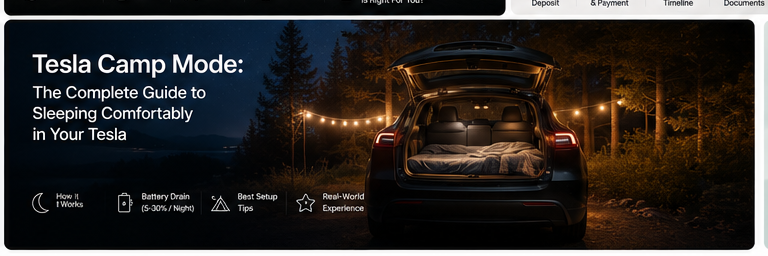
Camp Mode is the closest thing an EV has to a quiet, idling engine — except there's no engine, no exhaust, and no fuel burning while you sleep. Flip it on and your Tesla holds cabin temperature, keeps the touchscreen and USB ports alive, and ventilates the cabin through the night, all on battery. The catch is honest planning: overnight drain runs anywhere from about 5% in mild weather to 25-30% in deep cold, and the feature won't run below 20% so it never strands you without range. This guide covers what Camp Mode actually does, real-world drain figures, the CO2 and fresh-air details most write-ups skip, and which models are genuinely comfortable to sleep in.
Find your match, then never miss it.
Browse every used Tesla in the US free, or set a $29 alert and we ping you the moment your car appears or drops in price.
What Tesla Camp Mode Does (and Doesn't)
Camp Mode is a built-in climate-and-power setting on every current Tesla, added in software update 2019.40.50 (late 2019). You turn it on from the climate screen with the car in Park: open the climate controls and set Keep Climate On to Camp. Instead of letting the car drift into deep sleep, it deliberately keeps the cabin livable — climate running, air moving, devices charging — until you turn it off or the battery gets low. A handful of very early pre-2020 cars that never received the update won't have it; everything sold since does.
What it keeps on:
- Cabin climate — heating and air conditioning to your set temperature
- Ventilation and airflow
- Interior lighting
- USB ports and the 12V outlet, for charging phones and running small accessories
- The touchscreen — music, Tesla Theater, arcade, and apps stay available
What it turns off: Sentry Mode (and the alarm) and auto-locking doors — so you can come and go without setting anything off. The tradeoff: the car won't lock itself, so lock it manually from the screen or app before you settle in.
Takeaway: Camp Mode isn't a separate hardware feature — it's a software state that trades a predictable trickle of battery for a comfortable, powered cabin.
Real-World Battery Drain: What to Expect Overnight
Tesla estimates Camp Mode draws roughly 1% per hour — about 10% over an 8-hour night in mild conditions. That's a fair baseline, but owner data shows the real number swings a lot with outside temperature, your set cabin temp, and the model.
Typical overnight drain (8 hours):
- Mild (60-70°F / 15-21°C): roughly 5-10%
- Hot, AC working hard (85-100°F / 30-38°C): roughly 10-20%
- Cold (around freezing, 32°F / 0°C): roughly 15-25%
- Deep cold (below 5°F / -15°C): 25-30% or more
Heat-pump cars (Model Y, 2021-on Model 3) are a bit more efficient in the cold, but resistance-level heating still costs more energy than summer cooling in most climates — plan for the high end when it's freezing.
The 20% floor: Camp Mode won't start below 20% battery, and if you're already running it and drop to 20%, the car sounds a loud alert to wake you and powers the system down to protect your remaining range. Practical target: arrive with 60-70% battery (75-80% in winter). That covers the night and still leaves enough to reach a charger in the morning. Never plan a night that lands you near empty by sunrise.
Climate, Temperature & CO2 Safety
Temperature. Set your target on the climate screen (most people land around 64-72°F / 18-22°C). A battery-smart move: pre-condition the cabin hard for 10-15 minutes before bed, then nudge the set temperature a little closer to outside while you sleep — the climate system cycles less and sips less power.
Airflow. Camp Mode handles ventilation and dehumidification automatically; fan speed and direction stay adjustable from the climate menu. Owners generally find the cabin stays comfortable, though long runs can leave the air dry.
CO2 is the real safety variable — not carbon monoxide. There's no engine and no exhaust, so carbon monoxide isn't a risk. What does accumulate is the CO2 you exhale, and the single biggest factor is whether the car is pulling in fresh outside air or running on recirculation. Owner testing with cabin CO2 monitors is consistent: on recirculation a sealed cabin climbs past 1,000 ppm, with one sleeper often approaching ~1,200 ppm and two people pushing toward 2,000+ ppm; switching to fresh-air intake pulls levels back below 1,000 ppm within 10-20 minutes. Set the climate to fresh/outside air, not recirculation, and in mild weather (above ~50°F) crack a rear side window 1-2 cm for real air exchange. A mesh screen or rain guard keeps water and bugs out. For multi-night trips or two-plus sleepers, a cheap battery CO2 monitor is worth carrying.
Takeaway: the cabin is safe to sleep in — but fresh-air intake, not a sealed car, is what keeps it that way.
Which Teslas Support Camp Mode — and Which Sleep Best
Camp Mode ships on every current Tesla — Model 3, Model S, Model X, Model Y, and Cybertruck — at no extra cost, as long as the car is on software 2019.40.50 or newer. The feature itself works identically on all of them; what differs is how much room you have to lie down.
| Model | Sleeping verdict |
|---|---|
| Model X (7-seat) | Best of the lineup — both rear rows fold into a long, near-flat floor. Owners fit a queen-style mattress and lie out fully. (The 6-seat version doesn't work — the captain's chairs don't fold.) |
| Model Y | Excellent for two. Rear seats fold nearly flat for a full-size mattress — the most popular Tesla camper. |
| Cybertruck | Roughly 6-foot bed (about 51 in wide) plus tent accessories; Tesla's Tent Mode uses the adaptive air suspension to self-level the whole truck on uneven ground. |
| Model 3 | Workable with a contour mattress — best for one, snug for two. |
| Model S | Sedan proportions mean a single-sleeper setup; less usable flat space than the SUVs. |
One thing that doesn't matter: Autopilot hardware. HW3 vs. HW4 has zero effect on Camp Mode — it's standard software on both. (Hardware version matters a lot for Full Self-Driving, just not for sleeping in your car.)
Power: USB, Accessories & the Touchscreen
Keeping your gear charged is the whole point of Camp Mode — it's what separates it from simply parking and letting the car sleep.
- USB ports stay live for phones, tablets, and cameras
- 12V outlet powers small cabin accessories — a fan, a mini-fridge, a CPAP
- Touchscreen stays on for music, Tesla Theater, arcade, and browsing (streaming and the web browser need Wi-Fi or Premium Connectivity, $9.99/mo or $99/yr)
- Interior lights work without kicking the car into deep sleep
That screen-plus-climate draw is most of the ~1% per hour. If you want to stretch the battery, charge personal devices off a separate power bank and dim the cabin lights — but availability of power is the feature, so don't fight it too hard.
Tips for a Safe, Comfortable Night
Battery & route. Arrive at 60-70% (75-80% in winter). Subtract your expected overnight drain, then make sure what's left covers the morning drive to a charger with a 20-30% cushion. Don't cut it close.
Comfort. Pre-condition the cabin 10-15 minutes before bed. Save a seat layout called "Camp" with the seats folded so they don't shift when a door opens. A custom foam mattress or a good sleeping pad beats improvising on folded seats. Blackout shades buy you privacy and block streetlights.
Air. Fresh-air intake, never recirculation. Crack a rear window 1-2 cm in mild weather with a screen. Carry a CO2 monitor for longer stays or two sleepers.
Location & security. Sleep only where overnight parking is clearly allowed. Park nose-out so you can leave fast. The car won't auto-lock in Camp Mode — lock it yourself. Keep the key, a flashlight, and a phone within reach, valuables out of sight (the frunk is good), and tell someone where you are. Skip spots that feel wrong or sit under a severe-weather warning.
Finding the Right Used Tesla for Camping
If Camp Mode has you thinking about owning a Tesla for trips, UsedTesla.AI is an independent search front-end over Tesla's own official pre-owned inventory — we're not affiliated with Tesla, and you pay Tesla the same price you'd pay direct (we earn a small referral fee). The point is to show you the real listings with the details that actually decide a purchase:
- Hardware you can trust. We confirm HW3 vs. HW4 from each car's AP_HARDWARE_VERSION record — not guessed from the model year. (HW4 began rolling out in 2023 and broadened from there, so year alone never proves it.) See our HW4 guide for why this matters.
- True all-in price. Tesla charges a non-refundable transport fee that varies by distance (free for local pickup), so we surface the real delivery cost up front — no checkout surprises.
- Accident & title flags. Clean-title status and any reported accident history, shown before you commit.
- Free to browse. The full inventory, no signup.
- $29 alert pass. A one-time 60-day custom search alert — not a subscription, with a 7-day money-back guarantee.
For sleeping, the SUVs win: a Model Y handles two comfortably, and a 7-seat Model X is the roomiest of the bunch. Whatever you're after, UsedTesla.AI helps you find it with verified hardware and honest pricing.
Frequently asked questions
How much battery does Tesla Camp Mode drain overnight?
Tesla estimates about 1% per hour — roughly 10% over an 8-hour night in mild weather. In practice it runs 5-10% in mild conditions and 15-30% in cold, depending on outside temperature, your cabin setting, and the model. Arrive with 60-70% (75-80% in winter) so you can sleep and still reach a charger.
Is it safe to sleep in a Tesla with Camp Mode?
Yes, used correctly. There's no engine and no exhaust, so carbon monoxide isn't a risk. The thing to manage is CO2: set the climate to fresh/outside air rather than recirculation, since a sealed, recirculating cabin can climb past 1,000-1,200 ppm with one person and higher with two. Crack a rear window 1-2 cm in mild weather with a screen, arrive with 60-70% battery, camp only where overnight parking is legal, and keep emergency supplies within reach.
Which Tesla models support Camp Mode, and which is best for sleeping?
All current models support it — Model 3, S, X, Y, and Cybertruck — on software 2019.40.50 or newer. For sleeping, the 7-seat Model X is roomiest (both rear rows fold flat, fits a queen-style mattress), the Model Y is excellent for two, and the Cybertruck has a roughly 6-foot bed plus tent options. Model 3 works for one with a contour mattress; Model S is best as a single-sleeper setup.
Do I need to crack a window, and is there a carbon monoxide risk?
No carbon monoxide risk — there's no exhaust. Cracking a rear window 1-2 cm in mild weather (with a screen) improves air exchange but isn't strictly required. The real rule is to run fresh/outside air instead of recirculation, which keeps exhaled CO2 from building up over a long night in a sealed cabin.
Can I keep my phone charging and the screen on all night?
Yes. Camp Mode keeps the USB ports and 12V outlet powered and the touchscreen on for music, apps, and entertainment. That continuous power is the whole point — it's what stops the car from dropping into deep sleep and cutting the cabin off.
What's the difference between Camp Mode and Dog Mode?
Camp Mode keeps climate, the touchscreen, interior lights, and USB/12V power running for when you're inside the car, and it leaves the doors unlocked so you don't lock yourself out. Dog Mode keeps climate on and shows a reassuring message on the screen for passersby, but keeps the doors locked and doesn't power the touchscreen, interior lights, or USB outlets — so it draws less battery and suits short stops with a pet. Use Camp Mode to sleep, Dog Mode to leave a pet briefly.
Ready to find yours? Verified hardware, true all-in pricing, clean-history only.
Browse used Teslas →Keep reading